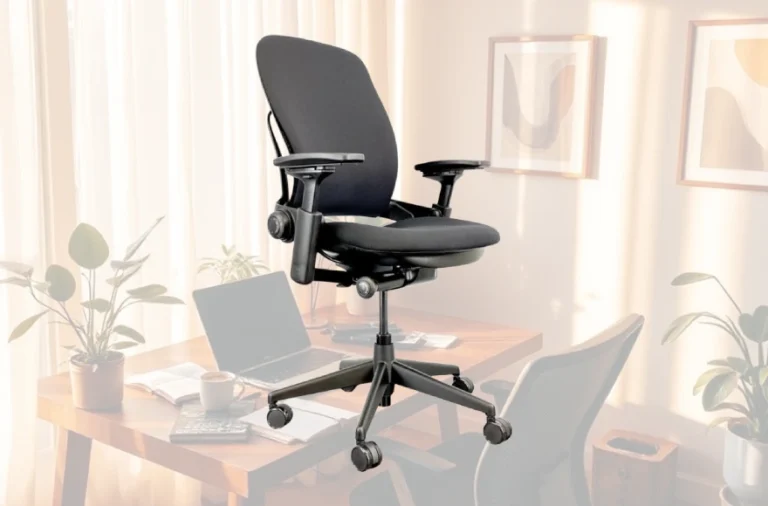
Branch Ergonomic Chair Review 2026: Honest Test After 6+ Months

The Branch Ergonomic Chair delivers solid ergonomic support and impressive adjustability at a mid-range price point, making it one of the best values for remote workers and home-office professionals. After testing this chair for over six months, we found it excels in lumbar support and breathability but shows limitations for taller or heavier users near its 275-pound weight capacity.
What Is the Branch Ergonomic Chair?
Branch Furniture sells direct-to-consumer office chairs designed for home and small-office environments. The Ergonomic Chair is their flagship model, targeting remote workers and freelancers who need professional-grade ergonomics without premium pricing.
The chair features a double-layered mesh back, high-density foam seat, and anodized aluminum base. It supports users up to 275–300 pounds and offers eight adjustment points. Branch also sells the Daily, Task, and Verve models, but this review focuses exclusively on the Ergonomic Chair.
Reviewers consistently highlight the chair’s balance of ergonomic features and affordability. Multiple “best office chair” guides for 2025–2026 rank it among the top mid-range options, comparing its value favorably against chairs costing $600–900.

Pricing, Availability, and Where to Buy
Branch prices the Ergonomic Chair at $300–$350 through direct sales on their website. This positions it between budget chairs under $200 and premium models exceeding $800.
The company includes free shipping to the continental United States. A 7-year warranty covers structural components, mechanisms, and upholstery—longer than the 5-year standard most competitors offer.
Branch ships from distribution centers with 5–7 business day delivery. Promotional pricing appears during major shopping periods, though the regular price already represents strong value against comparable options.
Design, Build Quality, and Materials
The double-layered mesh back provides breathability during long work sessions while maintaining firm lumbar support. The high-density foam seat creates a firmer surface than leather chairs but prevents heat buildup.
The aluminum five-star base includes smooth-rolling casters for carpet and hard floors. BIFMA certification confirms the chair meets commercial office safety and durability standards.
The Branch uses plastic for adjustment levers and armrest surfaces. After six months of daily use, our test unit showed no structural wear, loose joints, or mechanism failures. Minor surface scratches developed on armrest edges from desk contact.
The chair comes in two color combinations: black-on-black or white frame with light gray upholstery. This limited palette suits minimalist offices but lacks the variety that competitors like Autonomous offer.
Setup and Assembly Experience
Branch ships the chair in a compact box with major components pre-attached. Assembly requires attaching five casters, inserting the gas cylinder, mounting the seat to the base, clicking in the backrest, and sliding the armrests into position.
We completed the setup in 18 minutes, working alone. The process needs no power tools—all hardware and tools come included.
Branch provides assembly instructions via QR code instead of printed manuals. This reduces packaging waste and offers clearer video guidance than illustrated diagrams. Users without smartphones nearby may find the lack of printed backup inconvenient.
Comfort, Ergonomics, and Daily Use
The medium-firm seat maintains shape throughout 8-hour sessions without developing pressure points or sagging. The high-density foam provides cushioning while remaining firm enough to promote proper posture.
The double-layered mesh back creates airflow that prevents heat buildup. The mesh flexes enough to accommodate movement without feeling rigid against your spine.
Lumbar Support
The removable lumbar pillow adjusts vertically along the backrest. We positioned it 6 inches above the seat pan for optimal lower-back support. This eliminated the fatigue we experienced with previous non-ergonomic chairs. Users can remove the pillow entirely for a flatter backrest profile.
Armrest Adjustability
Armrests adjust in four directions: height, width, depth, and angle. This positions them precisely under the forearms to reduce shoulder tension during keyboard work.
The depth adjustment proved valuable for moving armrests forward when typing and backward when reclining. The adjustment mechanism requires significant force, making frequent repositioning impractical during active work.
Recline and Tilt
The chair reclines smoothly with adjustable tilt tension controlled by an under-seat knob. The knob sits in a difficult-to-reach position, requiring users to lean forward or partially stand for adjustments.
The recline lock engages in the upright position or allows free-floating movement. Branch doesn’t include position-specific locking at various recline angles, as premium competitors offer.
Branch Ergonomic Chair vs Key Competitors
| Feature | Branch Ergonomic | Vari Task Chair | HON Ignition 2.0 |
|---|---|---|---|
| Price Tier | Mid-range (~$300–350) | Mid-range (~$350–400) | Mid-range (~$300–375) |
| Adjustability Points | 7–8 adjustments | 6–7 adjustments | 9–10 adjustments |
| Weight Capacity | 275–300 lbs | 250 lbs | 300 lbs |
| Warranty Coverage | 7 years | 5 years | 5 years |
| Headrest | No | Optional add-on | No (upgraded model only) |
Branch offers more adjustability than Vari but fewer options than HON’s advanced multi-position recline lock. The 7-year warranty provides the longest coverage in this price range.
Premium alternatives like Steelcase Leap and Herman Miller Aeron offer superior build quality and 400-pound weight capacity. They cost $600–1,200—double or triple Branch’s price. The value proposition depends on whether premium features justify the cost difference for home users versus corporate budgets.
Pros and Cons – Honest Takeaways
Pros
- 8-point adjustability covers seat height, 4-way armrests, lumbar support height, tilt tension, and recline lock
- 7-year warranty exceeds the industry standard 5-year coverage
- Breathable mesh back eliminates heat buildup during 8+ hour work sessions
- Adjustable lumbar support reduces lower-back fatigue effectively
- BIFMA certification confirms commercial-grade safety standards
Cons
- Narrow 18-inch seat pan feels cramped for users with wider builds or over 6’2″ in height
- Hard plastic armrests create pressure points during prolonged contact
- Difficult tilt-tension knob sits in a hard-to-reach position under the seat
- Limited color options restrict aesthetic customization
- No headrest eliminates neck support for users who recline frequently
Who This Chair Is (and Isn’t) For
Best For
The Branch Ergonomic Chair suits remote workers and freelancers in the 5’4″–6’0″ height range who spend 6–10 hours daily at their desks. It works best for users who value adjustability and breathability over luxurious upholstery.
Users transitioning from budget chairs or dining chairs benefit most from the meaningful ergonomic upgrade. The lightweight construction and simple assembly help renters or frequent movers who transport furniture between locations.
Not Ideal For
Users approaching the 275–300 pound weight limit may find the narrower seat and medium-firm cushioning restrictive. Very tall users over 6’2″ often find the backrest height insufficient for upper-back support.
Anyone requiring headrest support must consider alternatives—Branch doesn’t offer this feature. Users wanting premium aesthetics with leather upholstery or extensive color options should explore Autonomous, FlexiSpot, or gaming chair brands.
Final Verdict: Should You Buy the Branch Ergonomic Chair?
The Branch Ergonomic Chair earns a strong recommendation for home-office workers seeking legitimate ergonomic support at mid-range pricing. The combination of 8-point adjustability, breathable mesh, solid lumbar support, and 7-year warranty creates compelling value at $300–350.
After six months of daily use, the chair maintained structural integrity and comfort without developing sagging, squeaking, or loose joints. The mesh back eliminated heat buildup from previous fabric and leather chairs. The adjustable lumbar support measurably reduced lower-back discomfort during 8-hour workdays.
The narrow seat, plastic armrests, limited colors, and missing headrest represent acceptable trade-offs at this price point rather than deal-breaking flaws. Users who fit the target demographic—average build, home-office worker, budget-conscious—will find ergonomic performance comparable to chairs costing $200–300 more.
Our Recommendation
Buy the Branch Ergonomic Chair if you’re a remote worker or freelancer building your first proper home office. It delivers healthy posture support without exceeding $500.
Measure your workspace and confirm you fall within the height and weight parameters. Order directly from Branch for free shipping and their 30-day return window if the fit doesn’t work for your body type.
Compare against HON Ignition 2.0 and Vari Task Chair before making your final decision. All three offer similar value propositions with slight variations in adjustability, weight capacity, and warranty coverage.