Steelcase Series 1 Review (2026): The Best Entry-Level Ergonomic Chair Under $500?

The Steelcase Series 1 sits in a genuinely interesting position. It’s not cheap, but it’s far from premium. What it offers is something most budget chairs can’t match: real ergonomic adjustability backed by a 12-year warranty, from a brand that builds chairs for Fortune 500 offices.
After six-plus months of daily use — including eight-hour workdays, late-night writing sessions, and the occasional gaming marathon — I can give you an honest answer on whether this chair delivers.
Short verdict: For students, remote workers, and early-career professionals dealing with back pain from cheap seating, the Steelcase Series 1 is the most credible entry-level ergonomic chair you can buy without spending four figures.

Quick Verdict – Who Should Buy the Steelcase Series 1?
The Series 1 suits anyone spending six or more hours daily at a desk who can’t yet justify a Steelcase Leap V2 or Herman Miller Aeron. It’s specifically strong for people in the 5’4″–6’1″ height range who need genuine lumbar support without breaking a $500 budget.
Buy it if you:
- Sit for six-plus hours daily and experience lower back fatigue
- Want adjustable lumbar support that actually moves where you need it
- Value warranty protection over five-plus years of ownership
- Work remotely and need office-grade build quality at home
Not For You If…
Skip it if you’re over 6’2″ — the back height tops out in a range that leaves taller users without adequate upper lumbar contact. Also skip it if you want a plush, padded seat. The firm foam seat divides opinion sharply, and some users never fully adapt to it.
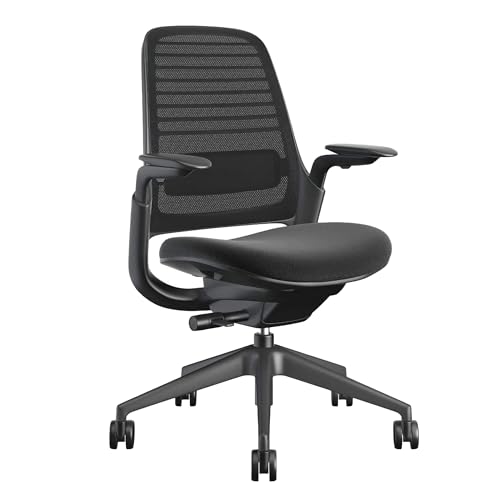
Design, Build Quality & Aesthetics
The Series 1 uses a steel base with reinforced polymer components throughout. It doesn’t flex or wobble. Pick it up and it feels dense — in a good way.
The mesh back is notably flexible. It contours as you shift position, unlike stiffer mesh designs on cheaper chairs. For comparison, the Gabrylly Ergonomic Mesh Office Chair uses a similar open-mesh back, but the Series 1’s weave holds its shape better after months of use with no visible sagging or distortion.
The seat pan uses dense foam with a waterfall edge — that gentle downward slope at the front that reduces pressure behind your knees. It’s firmer than padded competitors. That firmness is deliberate; it maintains posture rather than letting you sink.
Color options include black, navy, buzz2 red, and a few fabric variations. Nothing flashy. It looks at home in a corporate office or a clean home setup.
How It Compares to Series 2 & Leap V2
The Series 2 adds LiveBack technology — a flexible back that mimics your spine’s movement. The Leap V2 goes further with upper back flex and Natural Glide system recline. The Series 1 lacks both, but at roughly one-quarter the Leap V2’s price, that trade-off is entirely reasonable.
Ergonomics & Adjustability Deep Dive
This is where the Series 1 earns its reputation. Most chairs at this price offer height adjustment and maybe arm height. The Series 1 gives you significantly more.
Adjustment points include:
- Seat height (pneumatic, standard range)
- Seat depth (2-inch sliding range front-to-back)
- Lumbar height (raises and lowers independently)
- Lumbar depth (pushes forward or pulls back to match your spine curve)
- Tilt tension (resistance dial under the seat)
- Tilt limiter (locks at three recline positions or full float)
- 4D arms (height, width, depth, and pivot angle)
The 4D arms deserve specific attention. Most entry-level chairs offer 2D arms at best. Having pivot adjustment means you can angle the armrests inward for typing or outward for relaxed browsing. It’s a small detail with a real daily impact.
Step-by-Step Adjustment Guide
Getting the lumbar right matters most. Here’s exactly how to do it.
Lumbar height: Stand beside the chair and locate the dial on the lower right side of the back frame. Rotate it to raise or lower the lumbar pad until it aligns with the natural inward curve of your lower spine — typically between your hip crest and your navel.
Lumbar depth: Once height is set, use the second dial to push the lumbar pad forward until you feel it contact your lower back without forcing your torso forward. You want support, not pressure.
Seat depth: Slide the seat pan forward if you’re shorter, so your knees bend at roughly 90 degrees without the seat edge pressing into your thighs. Taller users should push it back.
Tilt tension: Sit in the chair at your working weight. Tighten the tension knob until you can recline with mild resistance — you shouldn’t feel like you’re fighting gravity or falling backward freely.
Getting all four adjustments right takes about ten minutes on day one. After that, you rarely touch them.
Real-World Comfort & Long-Term Use Testing
Six months of daily use taught me things no spec sheet covers.
The mesh back stays noticeably cooler than foam-padded alternatives. During summer months working from home, this matters more than you’d expect. Chairs with full foam backs trap heat within 90 minutes. The Series 1 doesn’t.
Noise is essentially zero. The tilt mechanism operates silently. Arms don’t rattle. After six months of regular recline and position shifting, nothing has developed a creak — which is more than I can say for chairs at similar prices that start clicking within weeks.
My Testing Scenarios (Home Office, 8hr Workdays, Gaming)
8-hour workdays: Lower back fatigue dropped noticeably in the first two weeks after switching from a basic task chair. The lumbar depth adjustment is the key differentiator — I set mine at medium depth and haven’t touched it since.
Gaming sessions (3–4 hours): The firm seat becomes mildly uncomfortable past the two-hour mark without movement. Gaming users who stay static may prefer a padded alternative. Taking a five-minute break hourly resolves this entirely.
Student desk work (writing, reading): Near-ideal. Lighter workloads mean less static sitting. The tilt float position actually encourages natural movement, which reduces fatigue better than a locked upright position.
No sagging in the seat foam after six months. The mesh back shows no deformation. Nothing suggests this chair won’t comfortably last a decade — which aligns with the 12-year warranty confidence.
Pricing, Warranty & Value Proposition
The Series 1 with 4D arms sits at approximately $487. Without 4D arms (2D only), the base model is meaningfully cheaper. Given how useful the arm pivot adjustment is daily, the 4D version is worth the premium.
That price sits above obvious budget competitors like the SIHOO M57 (around $300) and the Ticova Ergonomic Office Chair (around $350). It’s also nearly $200 more than something like the Clatina Mellet Chair or the HON Ignition 2.0, both of which offer solid mid-range ergonomics.
The 12-year warranty is the decisive factor here. It covers parts and labor — not just structural components. When you divide $487 by 12 years of coverage, you’re paying roughly $40 per year for a chair built to office contract standards. The SIHOO M57 carries a 3-year warranty. The Ticova offers 5 years. Neither competes on this metric.
Is It Worth the Upgrade Over SIHOO M57?
Yes — if adjustability and longevity matter to you. The SIHOO M57 is a capable chair, but it lacks seat depth adjustment and carries only a 3-year warranty. If you’re sitting eight hours daily, the Series 1’s lumbar depth control alone justifies the price difference. If you’re sitting four hours or fewer, the M57 is a perfectly adequate, cheaper solution.
Pros & Cons
| Feature | Assessment |
|---|---|
| ✅ 4D arm adjustments | Best in class at this price |
| ✅ Dual-axis lumbar (height + depth) | Matches chairs costing $200 more |
| ✅ 12-year warranty | Industry-leading for sub-$500 |
| ✅ Mesh back airflow | Stays cool in warm environments |
| ✅ Seat depth adjustment | Rare below $600 |
| ✅ Build quality / no creaks | Verified over 6+ months |
| ❌ Firm seat pan | Divides opinion; some never adapt |
| ❌ No headrest option | Not available as add-on |
| ❌ Limited recline depth | Only three lock positions |
| ❌ No adjustable back height | Fixed, which limits very tall users |
Best Alternatives & Comparisons
Not every buyer should choose the Series 1. Here’s where the alternatives genuinely win.
Comparison Table: Series 1 vs. Top 3 Alternatives
| Chair | Price (approx.) | Warranty | Lumbar | Arms | Seat Depth |
|---|---|---|---|---|---|
| Steelcase Series 1 | ~$487 | 12 years | Height + depth | 4D | ✅ Yes |
| SIHOO M57 | ~$300 | 3 years | Height only | 3D | ❌ No |
| Ticova Ergonomic | ~$350 | 5 years | Fixed | 3D | ❌ No |
| Steelcase Leap V2 | ~$1,200+ | 12 years | LiveBack | 4D+ | ✅ Yes |
SIHOO M57 review: The M57 undercuts the Series 1 by nearly $200. It’s a solid choice for lighter users or those sitting fewer than five hours daily. The 3-year warranty and absent seat depth adjustment are genuine limitations if you’re planning a long-term investment.
Ticova Ergonomic Chair: Ticova’s seat is softer and may suit users who find the Series 1 too firm. But the lumbar is fixed depth, and the 5-year warranty doesn’t approach Steelcase’s 12. Choose Ticova for comfort-first sitting; choose Series 1 for support-first ergonomics.
Branch Ergonomic Chair: Branch competes in the same price bracket with a cleaner aesthetic and decent lumbar support. It’s a legitimate alternative for design-conscious buyers. The Series 1 still wins on warranty depth and arm adjustability.
Steelcase Leap V2: This is where you go when budget is no longer the constraint. The Leap V2’s LiveBack system adapts dynamically with your spine — something the Series 1 can’t replicate. If your chair budget is $1,000-plus, the Leap V2 is worth every dollar. For X-Chair reviews as another premium alternative, that range also warrants consideration.
FAQs – Common Questions About the Steelcase Series 1
Is the Series 1 good for tall people?
It suits users up to approximately 6’1″ comfortably. Above that height, the lumbar pad may not reach high enough for effective support, and the seat depth at maximum extension still leaves some taller users without ideal thigh support. Taller buyers should consider the Leap V2 instead.
Does it have a headrest?
No. The Series 1 doesn’t offer a headrest — not even as an optional add-on. If neck support matters to you, this is a firm limitation. The Series 2 and Leap V2 both offer headrest compatibility.
How long does the warranty last?
Warranty Terms Explained
The Series 1 carries a 12-year, 3-shift warranty. This means it’s rated for three daily eight-hour shifts — 24-hour use scenarios in commercial environments. For home or single-shift office use, it’s essentially a lifetime warranty in practical terms. Coverage includes parts, labor, and foam components. Steelcase has a strong track record of honoring warranty claims without friction.
Can I get 4D arms on the base model?
You select arm type at purchase. The base model ships with 2D arms (height and width only). The 4D arm upgrade adds depth and pivot adjustment. It’s worth specifying 4D at checkout — retrofitting arms later isn’t straightforward.
Is the seat really that firm?
Yes. It’s noticeably firmer than foam-padded competitors. Most users adjust within two to three weeks. If you’ve sat in cheap foam chairs for years, the transition period is real. After that adjustment period, many users report the firmer seat actually reduces fatigue compared to sinking cushions.
Final Verdict
The Steelcase Series 1 is the most defensible ergonomic chair purchase under $500 in 2026. That’s not hype. It’s a conclusion backed by six months of daily use, clear adjustability advantages over similarly priced alternatives, and a 12-year warranty that no budget competitor matches.
It’s not perfect. The firm seat is a genuine barrier for some buyers. The absent headrest limits its appeal for people who lean back frequently. Taller users above 6’1″ should look elsewhere.
But for the 22–35-year-old professional or student spending eight hours at a desk, dealing with back fatigue from inadequate seating, and working within a real budget — the Series 1 solves the problem without compromise where it counts most.
Buy it if you sit long hours and want adjustable lumbar support, 4D arms, and long-term warranty protection.
Look elsewhere if you need a headrest, prefer a plush seat, or stand over 6’1″.
The Series 1 earns its reputation. It’s the entry point into chairs that actually support you — and that’s exactly what it’s meant to be.