6 Best Office Chairs for Small Spaces in 2026: Compact Picks That Don’t Feel Cramped

Finding the right chair for a tight workspace is harder than it sounds. Most chairs marketed as “small” still measure 26 to 28 inches wide once you include the armrests — wide enough to block desk drawers, scrape walls, or prevent the chair from tucking under a narrow desk.
A genuinely compact office chair does more than look lighter. It has a narrower seat, a base that rotates without hitting furniture, and armrests that either fold up or don’t exist at all. Seat depth matters too, especially for shorter users who end up perching at the edge of an oversized seat pan.
This guide covers six chairs chosen specifically for small workspaces — apartments, dorm rooms, bedroom desks, and shared multipurpose rooms. Each pick solves a different version of the space problem.


1. DUMOS Armless Small Desk Chairs — Best Budget Chair for Small Spaces

The DUMOS Armless Small Desk Chairs specifications confirm what the design suggests: this is a chair built to disappear into a small workspace.
No armrests. No bulk. Just a breathable mesh mid-back, a rolling base, and a height range of approximately 15.94 to 20.67 inches that works with most compact desks.
Key Features
- Armless design → slides easily beneath compact desks without blocking drawer pulls
- Breathable mesh mid-back → reduces heat buildup during longer desk sessions
- Adjustable seat height (15.94–20.67 inches) → fits a range of desk heights and user preferences
- 360-degree swivel and rolling casters → allow quick repositioning without lifting the chair
- 250 lb weight capacity → supports everyday use comfortably
Pros and Cons
Pros
- Compact footprint suits bedrooms, vanities, and apartment desks
- Lightweight construction is easy to move and reposition
- Breathable back keeps the chair from feeling stuffy in warm rooms
- Height adjustment accommodates varied desk surfaces
Cons
- No armrests means no forearm support during typing
- Mid-back design provides less upper-body coverage than high-back models
- Budget construction may feel less substantial under heavy daily use
Pricing
Budget-friendly tier — one of the most affordable options on this list.
Our Verdict
The DUMOS is a solid choice for students, apartment workers, and vanity users who need a chair that gets out of the way. It won’t replace a full ergonomic setup, but for two to four hours of daily use at a compact desk, it delivers solid value.
2. Ergohuman High-Back Executive Chair — Best for Adjustable Support in a Small Office

Not every small-space chair needs to be minimal. The Ergohuman High-Back Executive Chair measures roughly 26 inches wide by 27 inches deep—a footprint that fits most narrow workstations—while offering far more adjustment than a typical task chair.
This is the pick for remote workers who sit for six or more hours daily and can’t afford to compromise on support just because the room is small.
Key Features
- Adjustable lumbar support → lets users fine-tune lower-back positioning without accepting a fixed curve
- Seat height, seat depth, arms, and headrest all adjustable → accommodates different body proportions and desk setups
- Synchro-tilt mechanism → supports natural posture shifts instead of locking you in one position
- High-back mesh design → delivers upper-body coverage and airflow simultaneously
- Up to 300 lb capacity on the Generation 2 all-mesh model → handles a wider range of users
Pros and Cons
Pros
- Extensive adjustment range suits most body types and sitting styles
- Mesh construction encourages ventilation during long sessions
- High-back and headrest design supports shoulders and neck
- Defined footprint fits designated workstation areas well
Cons
- Tall back creates more visual presence than a compact task chair
- Premium pricing is a significant investment
- Still needs rear clearance for reclining — measure wall distance first
Pricing
Premium tier — priced above budget and midrange options.
Our Verdict
If your small space is a dedicated workspace and you sit all day, the Ergohuman earns its footprint. The adjustment range means you can dial it in precisely, which matters more over time than a lighter visual profile.
3. Herman Miller Sayl — Best Premium Chair for a Visually Small Room

The open-back design of the Herman Miller Sayl does something most ergonomic chairs can’t. It makes a room feel larger.
You can check Herman Miller Sayl features on the official product page, but the short version is this: the suspension back eliminates the thick foam panel found on most chairs, replacing it with a tensioned web that looks almost transparent from across the room. That visual lightness matters in a bedroom office or apartment living space.
Key Features
- Open suspension back → reduces visual bulk without removing structural support
- Adjustable seat height and arms → allows personalized desk positioning
- Compact-looking silhouette → integrates more naturally into living spaces than conventional ergonomic chairs
- Herman Miller build quality → supports long-term use with strong warranty coverage
Pros and Cons
Pros
- Genuinely distinctive design that suits mixed-use rooms
- Strong brand support and long-term reliability
- More refined aesthetic than most chairs in this category
- Works well in apartment offices where the workspace is always visible
Cons
- Premium investment — among the most expensive options here
- Visual compactness doesn’t reduce the actual floor footprint
- Less enveloping back support than a high-back model
Pricing
Premium tier — comparable to other Herman Miller products.
Our Verdict
The Sayl suits design-conscious users who spend real time at their desks and want a chair that belongs in a living space, not just a corporate cubicle. It’s the right premium pick when appearance and long-term quality both matter.
4. Tervo Model U — Best Foldable Chair for Small Spaces
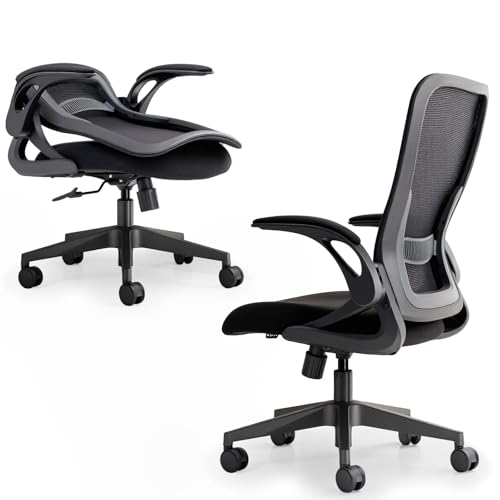
Most compact chairs are still chairs all the time. The Tervo Model U is different. Its backrest folds forward, letting the whole chair slide beneath a standard desk when you need to reclaim the floor.
The full Tervo Model U specifications are worth reviewing before buying, especially the working footprint of approximately 70 by 64 centimetres. That’s its size while you’re sitting in it — not dramatically smaller than other chairs. The value is in what happens after you stand up.
Key Features
- Foldable backrest → chair tucks beneath a desk when the room needs to serve another purpose
- Breathable high-rebound mesh → promotes airflow during extended work, study, or gaming sessions
- Detachable, height-adjustable lumbar support → can be repositioned or removed depending on preference
- Flip-up arms → create additional clearance for desk access and folded storage
- Alloy-steel construction with a 150 kg weight recommendation → supports solid everyday use
Pros and Cons
Pros
- Folding mechanism is genuinely practical in multipurpose rooms
- Flip-up arms add storage flexibility not found on most compact chairs
- Mesh back reduces heat buildup during long sessions
- Lumbar support can be adjusted or removed to suit different users
Cons
- Working footprint is full-size — it’s not narrow while in use
- Folding doesn’t make it a space-saver during working hours
- Fewer premium ergonomic customizations than high-end alternatives
Pricing
Midrange tier — above budget options, below premium ergonomic chairs.
Our Verdict
The Tervo Model U solves a specific problem: you need a proper desk chair, but you also need the floor back after work. For dorm rooms, shared living spaces, and multipurpose bedrooms, that’s a real advantage.
5. BTOD Petite — Best Petite-Specific Compact Chair
Here’s the thing most compact chair guides miss. A chair can be narrow and still feel wrong — if the seat is too deep, shorter users end up perching at the front edge, which cuts off circulation behind the knees.
The BTOD Petite is built around smaller body proportions from the start. You can find more detail in our guide to the best office chair for short people, but the core advantage here is geometry, not just external size.
Key Features
- Petite seat geometry → supports better thigh and knee positioning for shorter adults
- Adjustable seat height → improves compatibility with lower desk surfaces
- Narrower seat pan → reduces excess width that would otherwise spill toward desk edges
- Ergonomic adjustment options → offer more adaptability than basic small chairs
Pros and Cons
Pros
- Purpose-built for smaller users rather than scaled-down from a standard model
- Better knee and thigh fit than generic compact chairs for petite adults
- Practical ergonomic adjustments without unnecessary bulk
- More targeted value than upsizing to an oversized premium chair
Cons
- Less suitable for taller or larger users
- Availability may vary depending on region
- Product styling is less familiar than major-brand alternatives
Pricing
Midrange tier — positioned between budget task chairs and premium ergonomic models.
Our Verdict
If your real problem is user fit rather than floor space, the BTOD Petite is the right answer. It doesn’t just shrink the chair’s external dimensions — it reconsiders them for a different body type entirely.
6. Serta Armless Small Home Desk Chair — Best Budget Chair for Tight Workspaces
The Serta Armless Small Home Desk Chair specifications show a chair built around two priorities: fitting smaller spaces and keeping the price accessible.
At approximately 17.6 pounds and with an armless profile, it moves easily between a bedroom desk and a vanity — the kind of flexibility that matters in a multipurpose room.
Key Features
- Armless design → keeps the profile narrow and allows the chair to tuck under compact surfaces
- Breathable mesh back → encourages airflow during desk work and study sessions
- Faux-leather foam seat at approximately 16.5-inch depth → can better accommodate shorter users’ thigh length
- 360-degree swivel with rolling casters → simplifies repositioning across different work surfaces
- Up to 275 lb weight capacity → handles a range of users in everyday use
Pros and Cons
Pros
- Compact armless silhouette works in the tightest rooms
- Lightweight at approximately 17.6 pounds — easy to relocate
- Cushioned seat provides a softer surface than mesh-only designs
- Budget-accessible price point for students and apartment renters
Cons
- Fewer ergonomic adjustments than mid-tier or premium chairs
- Armless design offers no forearm support during extended typing
- Compact seat dimensions may feel limiting for larger users
Pricing
Budget-friendly tier — among the most affordable armless options available.
Our Verdict
The Serta Armless is the practical pick for a bedroom workstation that needs to double as a vanity area or shared surface. It won’t replace a full ergonomic chair, but for shorter daily sessions in a tight room, it earns its place.
Quick Comparison: All 6 Chairs at a Glance
| Chair | Armrests | Footprint Type | Best For | Price Tier |
|---|---|---|---|---|
| DUMOS Armless | None | Narrow | Budget compact use | Budget |
| Ergohuman High-Back | Adjustable | Defined | All-day ergonomic support | Premium |
| Herman Miller Sayl | Adjustable | Standard | Visual lightness, design | Premium |
| Tervo Model U | Flip-up | Standard (foldable) | Storage after use | Midrange |
| BTOD Petite | Adjustable | Narrow | Petite users | Midrange |
| Serta Armless | None | Narrow | Budget bedroom desk | Budget |
How to Choose the Best Office Chair for a Small Space
You’ve found the right chairs. Now here’s how to confirm the right one for your specific setup. These four questions will narrow it down fast.
Measure the Chair Footprint, Not Just the Seat Width
The seat width tells you almost nothing useful on its own. What matters is the total width, including armrests and the base diameter, which typically ranges from 24 to 27 inches across on a five-caster star base.
Measure your actual desk opening and the distance to any nearby walls or furniture before ordering. Allow at least 18 inches behind the chair for comfortable seated movement, and more if you plan to recline. Good computer workstation setup guidance from OSHA outlines how chair clearance and desk positioning interact with overall posture and health.
Check Under-Desk and Rear Clearance
Can the chair slide under the desk when you push back? Test this by measuring from your desk surface to the floor, then compare it with the armrest height of any chair you’re considering.
Armless chairs pass the test almost every time. Chairs with fixed arms often don’t. Flip-up arms split the difference — they clear when raised, and provide support when lowered.
Choose the Right Seat Depth
This is the most overlooked measurement in small-space chair buying. A seat that’s too deep forces shorter users to sit at the edge, which removes lumbar contact and increases pressure behind the knees.
Look for a seat depth under 17 inches, or a chair with adjustable seat depth, if you’re under approximately 5 feet 4 inches tall. Our guides on the best office chair for petite women and the best ergonomic office chairs cover this in more detail. If you sit for extended periods, also check our guide to the best office chair for long hours before deciding.
Decide Between Fixed, Flip-Up, and Armless Designs
Armless chairs give you the smallest footprint and slide under almost any desk. They do remove forearm support, which matters if you type for more than a few hours daily.
Flip-up arms offer the best of both. They rest in place during work, then fold up when you need to push the chair under the desk or move it aside. Fixed arms are the least flexible option in a small space — avoid them unless desk clearance isn’t a concern.
Budget matters here too. Our best office chair under $200 guide covers affordable options with flip-up arms. For breathable alternatives, the best mesh office chair roundup breaks down ventilation differences across price points. If lower-back comfort is a priority, our guide to the best office chair for lower back pain adds useful context without overcomplicating the decision.
If your small space uses a height-adjustable desk, cross-reference with our best office chair for a standing desk recommendations. And if you’re dealing with hardwood floors in a tight room where caster movement matters, the best office chair for hardwood floors guide covers that specifically.
When evaluating long-term durability, look for chairs that meet office-chair durability standards set by BIFMA — the industry body that tests load capacity, stability, and structural performance.
Final Verdict
The DUMOS Armless is the best overall pick for most small spaces — affordable, narrow, and genuinely compact enough to slide under a tight desk without modification.
Need all-day support in a defined workspace? Go with the Ergohuman High-Back. Want a premium chair that makes the room feel bigger? The Herman Miller Sayl is unmatched in visual lightness. Need to reclaim floor space after work? The Tervo Model U folds away beneath your desk.
Shorter users should prioritize the BTOD Petite for proper fit, or the Serta Armless for a budget-friendly shallow-seat option. Fit and clearance matter more than the smallest advertised dimension. Measure your space first, then choose.
FAQ
What is the best office chair for a very small room?
Prioritize a narrow base, flip-up or no armrests, and confirmed desk clearance. The DUMOS Armless and Serta Armless both fit that profile at a budget price.
Are armless office chairs better for small spaces?
They offer the smallest working footprint and slide under almost any desk. The trade-off is no forearm support, which matters for longer typing sessions.
How wide should an office chair be for a small desk?
Total width — including armrests — should stay under 25 inches to fit most compact desks. The base diameter also needs enough room to rotate without hitting walls or drawers.
What is the best compact office chair for a short person?
Look for a seat depth under 17 inches and a minimum seat height below 17 inches. The BTOD Petite and Serta Armless both suit shorter users better than most standard office chairs.